
Springfield City Directory Collections
Springfield has no municipal clerk’s directory series because it is an unincorporated Fairfax County community. The useful historical collections are instead regional, county, and neighborhood publications held or described by the Fairfax County Public Library’s Virginia Room. They range from rural-era gazetteers to reverse street books and highly local civic directories. Each is a dated publication, not proof that every household appeared. Start with the volume nearest the year of interest, record the exact spelling and address as printed, and then compare a second source before treating a name as a household match.
| Collection | Documented years | Holder | Access route |
|---|---|---|---|
| Springfield-Franconia Directory | 1961 | Virginia Room, VRARE 917.5529 S | Request the local volume |
| Hill’s Alexandria suburban/Fairfax directory | 1966, 1968, 1969, 1971-1973 | Virginia Room guide | Regional and reverse street research |
| Springfield/Lorton Community Directory | 1981 through 1994-95, with gaps | Virginia Room | Community household snapshots |
| Springfield Handbook | 1994-1999 | Virginia Room, VREF 917.5529 S | Reference volume |
| Northern Virginia/Washington white pages | 1962-2018 | Virginia Room | Subscriber history, not every household |
The year gaps matter. A Springfield/Lorton volume may be separated from the next one by several years, and telephone books normally reflect subscribers rather than all occupants. Earlier county volumes also use post-office or regional labels. The Virginia Room’s city-directory and telephone-book guide is the best starting catalog for call numbers and documented runs.
Springfield Directory Research at Virginia Room
The Virginia Room is on the second floor of City of Fairfax Regional Library, 10360 North Street, Fairfax. It is the local-history route for Springfield directories, maps, newspapers, yearbooks, photographs, manuscripts, rare books, and oral histories. Eight internet stations, a designated CPAN station, and a microform reader-printer with USB saving make it possible to compare a directory entry with a land-record clue in one visit. The regional library lists Monday through Wednesday hours of 10 a.m. to 9 p.m. and Thursday through Sunday hours of 10 a.m. to 6 p.m.; confirm staffing and holiday hours before a trip.
Reference staff can direct a researcher to a shelf call number or finding aid, but a printed index is not the same as a universal person search. Ask for the title, year, community name, and whether the item is on microform or in reference. Licensed genealogy databases are available in the library, while online scans may omit pages or have faulty text recognition.
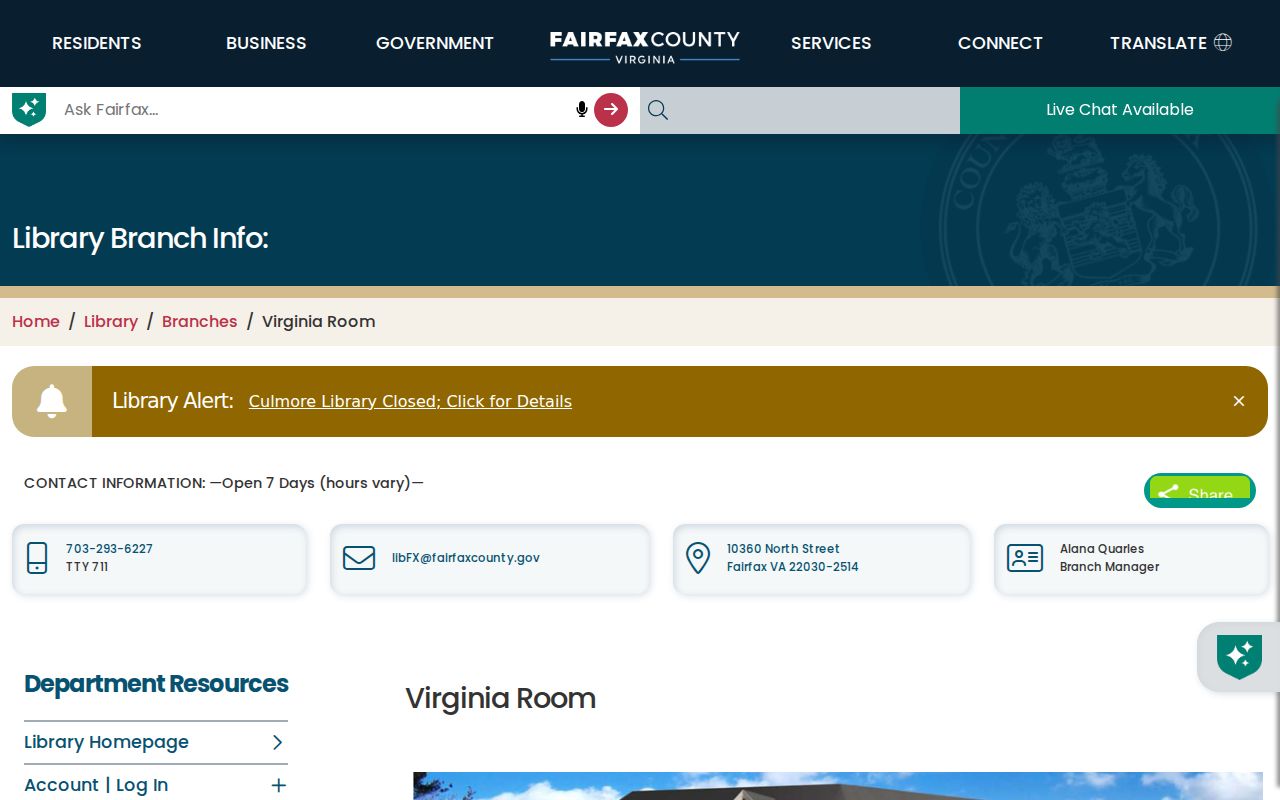
The Virginia Room’s local-history access page shows the research setting used for a Springfield historical-directory search.
Springfield Community Directory Years
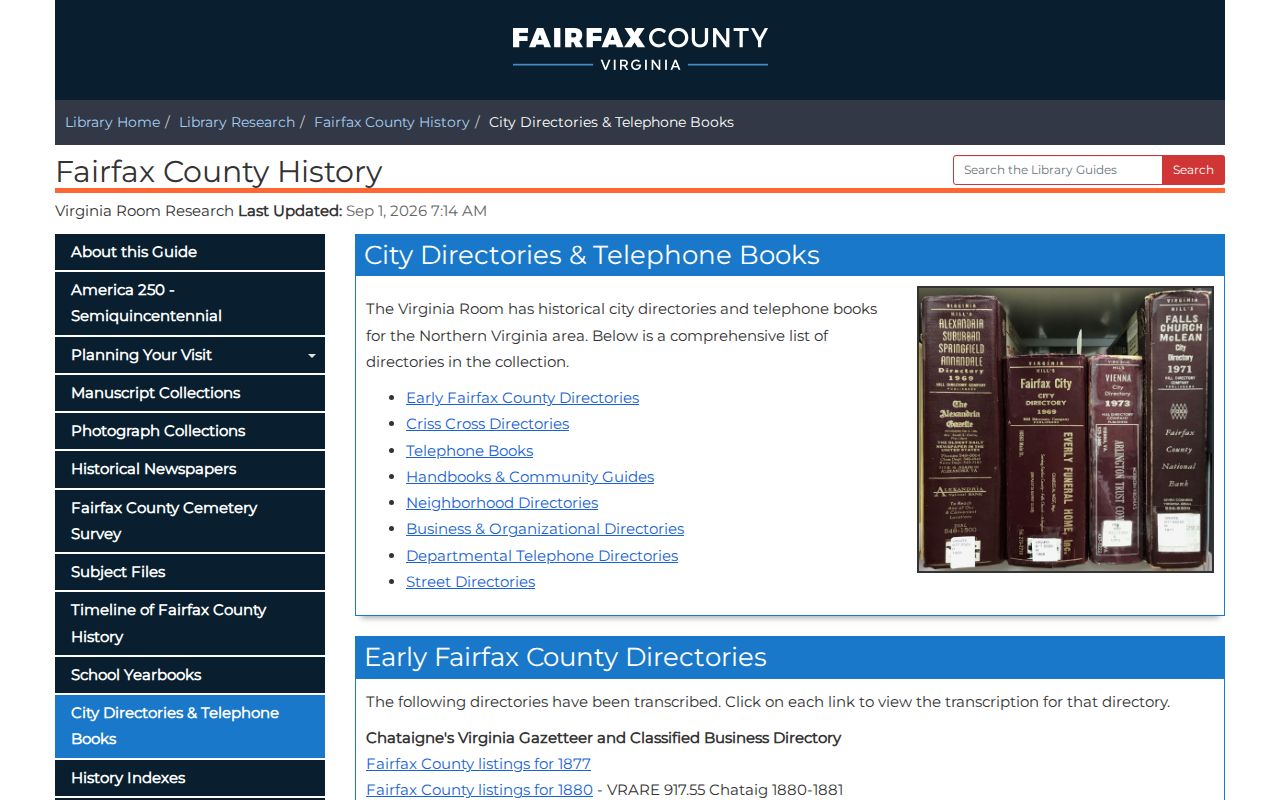
Some of the most useful city directories are neighborhood books rather than broad metropolitan volumes. The 1961 Springfield-Franconia Lions Club directory and the 1975 Springfield Virginia Directory preserve local organizational publishing. Springfield/Lorton community directories appear for 1981, 1982-83, 1983-84, 1984-85, 1985-86, 1986-87, 1989, 1990-91, and 1994-95. The Springfield Handbook follows with 1994, 1995, 1996-97, 1997-98, and 1999. Their narrow geography can make an address easier to place, but inclusion may have been voluntary, commercial, or tied to the publication’s purpose.
A Fairfax County directory-collections view documents these runs alongside telephone books and regional titles.
When a volume uses Springfield, Franconia, North Springfield, West Springfield, or Fairfax County, preserve that label in the notes. These names describe overlapping community, postal, district, and regional geographies. They should not be silently converted into the independent City of Fairfax.
Springfield Neighborhood Directory Books
Neighborhood publishing creates a more granular record of how residents identified their own communities. Kings Park Civic Association produced annual directories from 1966 through 1973 and later runs through 2018-19. West Springfield Civic Association volumes span 1964-71, 1972-76, 1978-80, 1988-90, 1995, and 1997-2001. Springfield Forest has a 1962/1963 directory, while Edsall Park has a 1978-79 volume. A name found in one of these books is evidence of its printed neighborhood snapshot, not proof of present residence or an official registration.
These books are especially useful when family members remember a subdivision but not a street number. Pair the directory’s neighborhood name with the printed address, then check a deed, map, newspaper, or later directory. Current civic organizations do not supply a public resident roster in the researched sources, so a historical directory should not be used to infer current membership.
Digitized Springfield Directory Leads
Digitization is a useful first pass, not a replacement for the local shelf. The Virginia Room guide identifies Hill’s Alexandria suburban/Fairfax County runs that include Springfield. A regional Hill’s directory record at Google Books provides a scan route associated with the University of Virginia and Google Books. Search the visible page image rather than trusting a short result snippet, and write down the directory year and page number before comparing it with another volume.
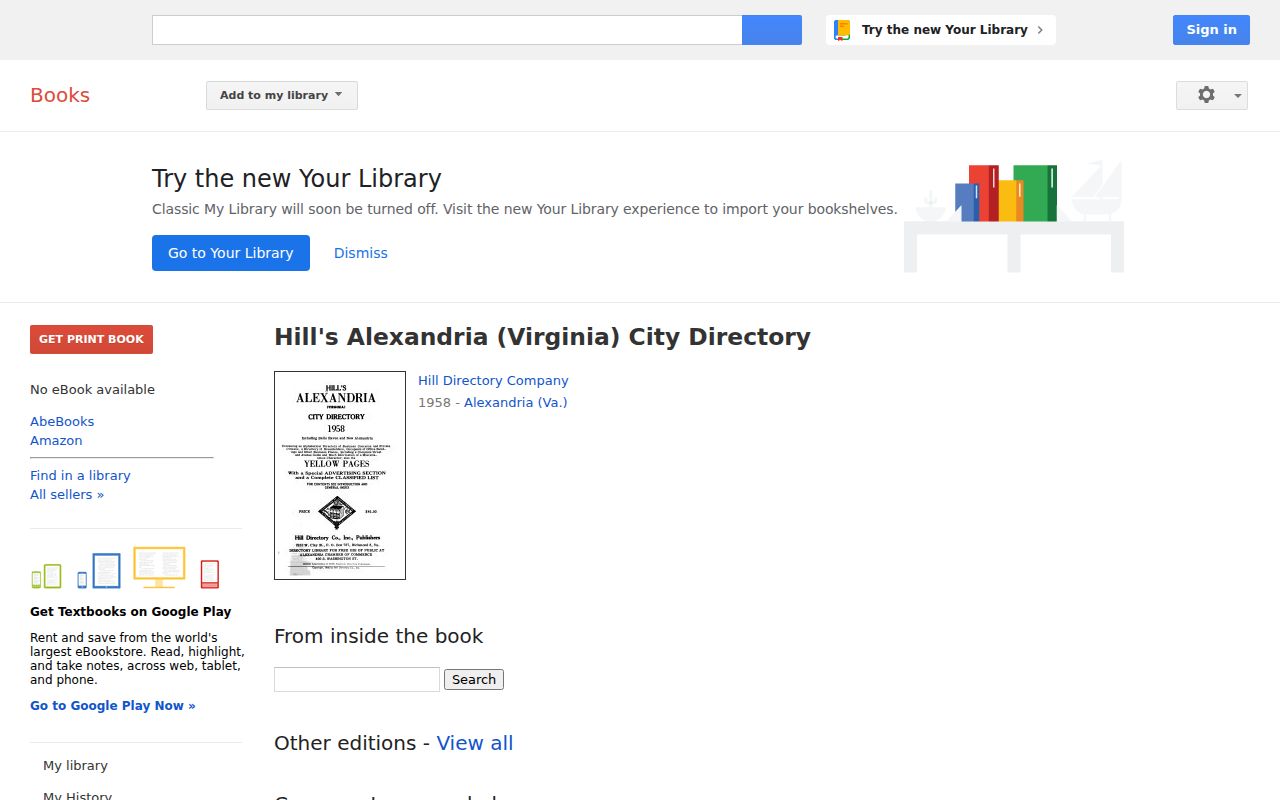
For a street question, Hill’s reverse or criss-cross format is valuable because it can be arranged by address rather than by surname. The collection guide also points to Haines Criss-Cross Northern Virginia at Arlington Center for Local History, an external fallback because the Virginia Room does not hold that series.
Reading a Springfield City Directory Entry
Read an old entry as a transcription task. In the scanned-directory convention inspected for the Hill’s route, the useful fields are the name as printed, street address, occupation or business role, employer or abbreviation, directory year, page number, and any cross-reference or household note visible on that actual page. The research did not expose a stable page image with an exact Springfield abbreviation key, so do not assign a meaning to a mark without checking the front matter of the volume that contains it. A directory can point to a household lead, but it cannot establish every relationship or date.
| Name as printed | Transcribe surname, initials, spelling, and any cross-reference exactly. |
|---|---|
| Address | Capture the number, street, suffix, neighborhood or postal label, and page number. |
| Work or business text | Record an occupation, business role, employer, or abbreviation only when it appears on the page. |
| Household clue | Preserve any spouse, boarder, or household notation, but verify it in another source. |
| Directory context | Keep the title, publication year, and the abbreviation key from that volume. |
Names may be listed as initials, under a spouse’s surname, or under a business entry. The safest match uses two independent clues, usually the address plus another dated record. That practice avoids treating a same-name entry as the right Springfield family.
- Criss-cross directory
- A reverse directory arranged by street and number, useful for locating the printed name attached to an address in that edition.
- Householder index
- An index organized around the household or address, when the particular publication supplies one.
- Abbreviation key
- The volume’s own list of shortened terms. Check it before expanding a business or relationship notation.
Springfield Directory Companions
Directory research becomes stronger when it is paired with the local materials that explain a name or address. The Virginia Room holds local newspapers, historical newspaper indexes, maps, yearbooks, oral histories, and property-history guides. The Historic Records Center handout also identifies Fairfax Historical Society yearbooks from 1951 through 2008. Those sources can help place a household between directory volumes or confirm an organization named in a community book. A standalone public Springfield obituary index was not located, so ask the Virginia Room for the newspaper title and date range rather than assuming a name is searchable online.
The Historical Society of Fairfax County is a useful contact gateway for holdings and annuals.
Springfield Directory Place Names
Historical place names are a practical search tool. Springfield Station began after the 1851 railroad reached Springfield Farm. The official marker records a Springfield post office in 1866-68, a Corbett post office in 1907, a return to the Springfield name in 1910, and a post-office move in 1953. A person absent under a modern street label may be described instead by Springfield Farm, Corbett, Springfield Station, a railroad place, a subdivision, or Fairfax County.
Before modern numbering, a directory or record may tie a person to a farm, tract, parish, road, or nearby landowner. The Historic Records Center’s 1760 owner/tenant map and 1860 biography/tax map are bridges for that older geography. A City of Fairfax result needs separate treatment because it is an independent locality, even though the Virginia Room is physically located there.
Note: Preserve the place label exactly as the source prints it, then compare the date and jurisdiction before merging it with a modern Springfield address.
Tracing Springfield City Directory Households
A household trail should move one printed date at a time. Begin with a known Springfield address or name, check the closest community or regional volume, and record the exact text instead of modernizing it. Next, look for the same street or surname in the next available edition. Address changes can reflect a move, a new postal label, a changed street description, or a different person with the same name. Compare each entry with a deed reference, map, newspaper, tax record, or census schedule before drawing a family conclusion.
- Choose the directory title nearest the known year and transcribe the name, address, title, year, and page.
- Check the next available Springfield or regional volume and note whether the name, address, and neighborhood label changed.
- Use a criss-cross section when available to test the address from the street side.
- Pair the dated directory entries with the relevant census, deed, newspaper, map, or tax evidence instead of relying on one book.
- Use probate, obituary, cemetery, or Historic Records Center material to close a trail that ends after a death or estate transfer.
Someone who disappears may have moved, died, been missed by a voluntary listing, used another name, or simply fall inside a gap between surviving volumes. For a present-day address question, move to the Springfield street directory for the county’s address-keyed records rather than treating a historical book as a current list.
Springfield Directory Timeline
Springfield’s published directory trail follows the area’s shift from rural post-office references to suburban neighborhoods. Fairfax County grew from roughly 40,000 people in 1940 to 454,000 in 1970, a change reflected in the move toward telephone, civic, reverse-street, assessment, and permit records. The timeline below is a finding aid, not a claim of uninterrupted coverage.
| 1961 | Springfield-Franconia Lions Club directory documents a hyper-local community volume. |
|---|---|
| 1962 onward | Springfield Forest and other neighborhood books begin the suburban civic-directory era. |
| 1966 onward | Hill’s regional criss-cross runs offer address-side research for Springfield. |
| 1981-1995 | Springfield/Lorton community volumes appear in documented, but not continuous, runs. |
| 1994-1999 | The Springfield Handbook adds a later local publication sequence. |
Keep the gaps visible in a research log. A missing directory is an access problem or publication gap, not a finding about a person.