
Walk a Springfield Street Directory
Fairfax County keeps the useful local trail because Springfield is a community within the county, not an incorporated city with its own assessor or recorder. Begin with the address, then use a parcel identification number, or PIN, as the link between sources. The assessment record can show the situs, or property location, physical details, mailing information, and deed references. It is a starting point, not proof that a particular person currently occupies the address. A printed directory is also a dated snapshot, not a current roster.
- Run the full address through Fairfax iCare and save the PIN, property location, mailing line, and visible deed references.
- Open Jade GIS with the address or PIN. Check the parcel context and adjoining lots, but do not treat a map boundary as legal title.
- Confirm the county address in the Master Address Repository, or MAR. Its current and historical status can expose an address change.
- Use the grantee name and book or instrument reference in the Circuit land-record route. Read the legal description before linking an older deed to the current address.
- For an earlier household lead, compare a dated criss-cross or community directory at the Virginia Room with the property and deed record.
The sequence separates three questions that are often confused: where the county places the site, who is named in an assessment or deed, and which historical publication printed an address. If the question is about one person rather than a road, the Springfield resident lookup has a different name-first workflow.
Search Springfield Streets in iCare
The Fairfax County Real Estate Assessment Site, known as iCare, is the practical first stop for a Springfield street search. Its address form is case-insensitive. A partial street name can use an asterisk before or after the text, while a broad request can produce hundreds of results. Use the street number to narrow the list, then open the result row for the printable property record. The assessment fields have their own dates: ownership and sale information is updated twice weekly, while assessed values are set as of January 1 for the tax year.
| iCare field | Entry style | Street-search use |
|---|---|---|
| Number | Text | Use the exact street number when it is known. |
| Unit | Text | Add an apartment or condominium unit when applicable. |
| Street | Text | Use a full name or a wildcard such as Sun*. |
| Suffix | Dropdown | Leave it blank for a broad search; the live options are generated by the portal. |
| Results controls | Pagination | Narrow a large response and open the matching detail record. |
The iCare address-search screen shows the number, unit, street, and suffix fields used for a Springfield street search.
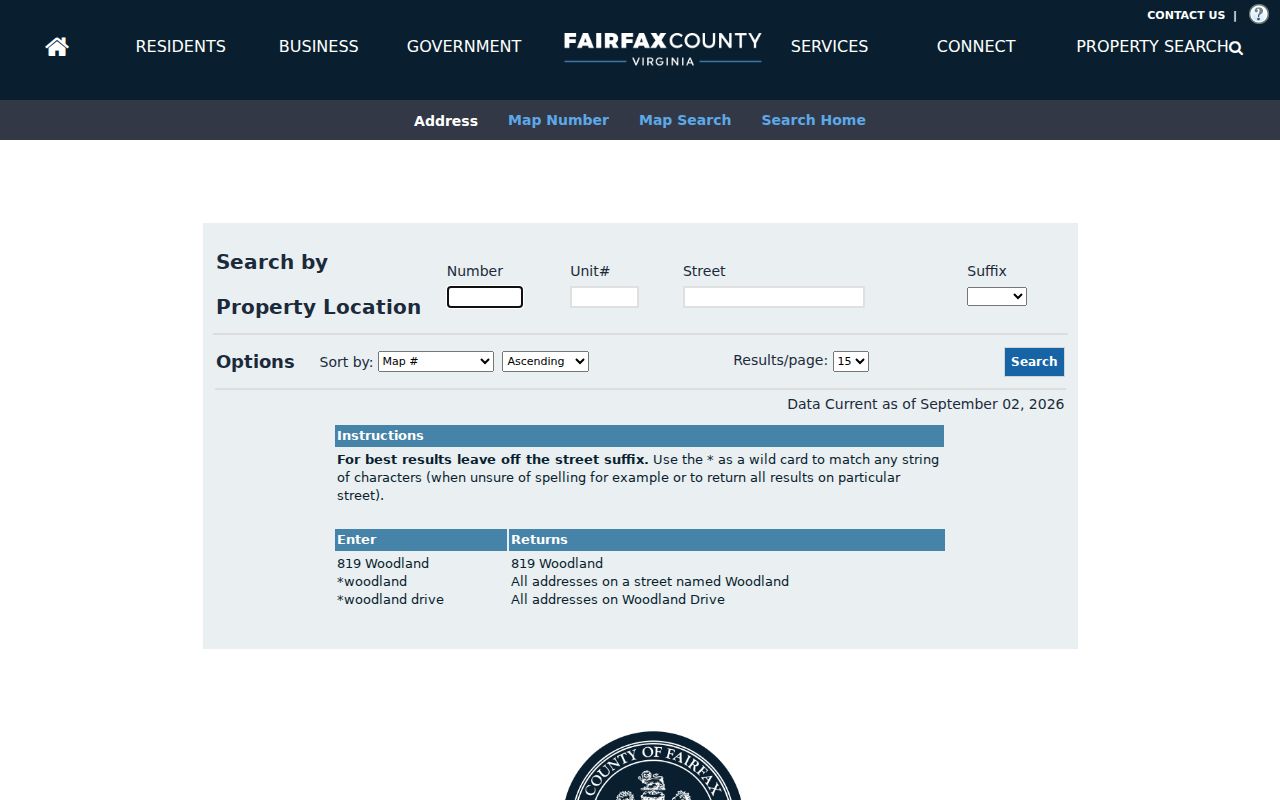
That form supplies a parcel lead. It does not supply a complete household list, and a result should be checked against the address, PIN, and source date.
Read a Springfield Address Card
A Springfield address review needs a clear distinction between situs and mailing address. The situs is the place on the ground. A mailing line may be a post office box or may be outside the community. Fairfax's inspected parcel card for 9003 Penn Manor Ct shows a Springfield situs, a Springfield post-office-box mailing address, the Lakewood Hills subdivision, a PIN, assessment fields, and several deed references. The owner field is withheld by request. Those visible details are useful navigation keys, but none establishes a current household.
- Parcel
- A defined piece of land in the county assessment and mapping systems, usually linked by a PIN.
- Situs address
- The physical location of the parcel, distinct from the line where mail is sent.
- Plat
- A recorded map that lays out lots, blocks, streets, or subdivision boundaries.
- Criss-cross directory
- A dated reverse directory arranged by address instead of by personal name.
The sample Fairfax parcel card illustrates why a Springfield address and a mailing label should not be treated as the same fact.
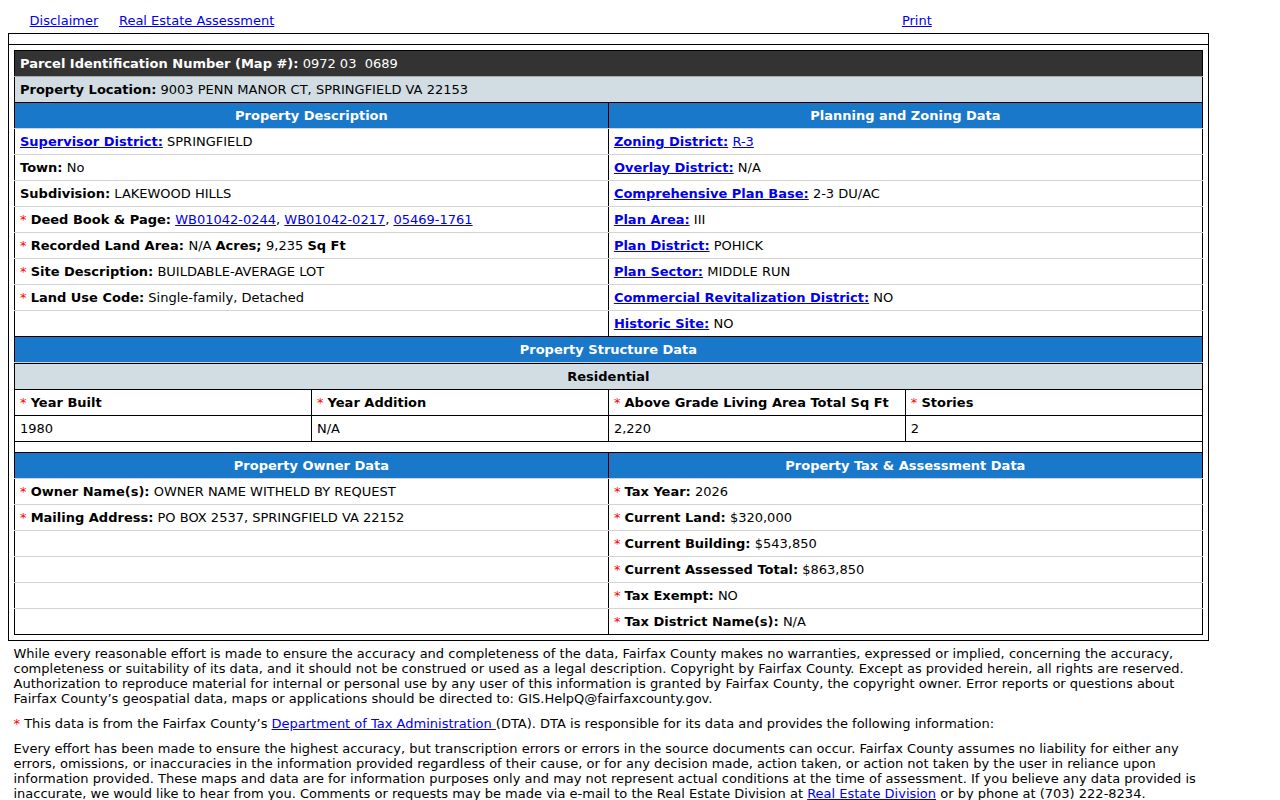
Use the card's deed book and page references to move into land-record research, while keeping the withheld online name and the distinct mailing line intact.
Trace Springfield Address Changes
MAR is the county's authoritative address repository, and it is especially useful when a Springfield address search finds a number that no longer matches an older record. Its Address, Parcel, and Street pages can filter by number, street name and type, city, ZIP, PIN, subdivision, date range, and current or historical status. The table and map update together, and the action menu can export a CSV. MAR is updated daily, but it is address data, not a deed image or a person index.
| MAR field | Street research use |
|---|---|
| FULL_STREET_NUM / STREET_NUM_SUF | Official number and any number suffix. |
| STREET_NAME / STREET_TYPE | Use these to normalize spelling and suffix changes before comparing records. |
| ADDRESS_STATUS | Current, historical, or all, a useful starting point for a changed address. |
| ADDRESS_EFFECTIVE_DATE | A clue to when the address became effective. |
| ADDRESS_CHANGE_DATE / EXPIRATION_DATE | Timing clues that require support from plats, deeds, or directories. |
| PARCEL_PIN | The join key to iCare, Jade, and land records. |
MAR excludes the independent City of Fairfax, Falls Church, Arlington, and Alexandria, and its web description limits apartment-unit coverage. Those boundaries explain a missing result in some regional searches. They are not evidence that a Springfield address is invalid.
Map a Springfield Street in Jade
Jade provides the map context for a by-address investigation. It can search by PIN, address, street intersection, and subdivision, then identify a parcel, select features, build a buffer, export a result, or switch between current and historical layers. Fairfax reports more than 170 layers. The adjacent-parcel view is useful for making a street inventory, especially where a street crosses a subdivision boundary or a parcel uses a different mailing label.
Use Jade with the iCare PIN, not as a substitute for the title record. Fairfax specifically warns that GIS easement layers are incomplete. Its My Neighborhood tools can return public services, polling place, and facilities around an address, but they do not return a public list of people on that street. Note: Save the map date and selected layer because a map result is context, not legal proof.
Check Springfield Site Records in PLUS
For a construction, plan, complaint, or site-history question, use Fairfax PLUS after confirming the address. The general search accepts street name, number, unit, city, state, ZIP, parcel ID, record number, and project information. Its record types include Building, Enforcement, Environmental Health, Fire, Planning, Site, and Zoning. A PLUS hit can place a dated activity at the site, but an applicant, contractor, or recorded owner is not automatically the occupant.
Older land-development material may sit outside PLUS. The fallback is the county's historical land-development route, the Historic Records Center, or the relevant county office. PLUS HistoryMap can supply visual clues about expired features and parcels; confirm any conclusion in the underlying land or development file.
Note: A site-record date can help place work at an address, but it does not identify everyone associated with the property.
Compare Springfield Street Records
No single county record system contains all address-linked information. The county systems below answer different questions, and each needs a date and a second matching key. A PIN connects the address record, parcel map, assessment card, and many deed clues. The street spelling provides a second path through MAR and older directories. Virginia voter access is qualified by statute, so the individual Citizen Portal should not be presented as a public street roster.
| Address record | What it can show | Springfield access route |
|---|---|---|
| iCare parcel card | Situs, mailing line, assessment, parcel features, deed references, and an owner field when visible. | Free address, map, PIN, and related iCare searches; DTA office or phone for an online-withheld name. |
| MAR and Jade | Official address metadata, PIN, parcel geometry, subdivision, address status, and map context. | County web tools, with MAR CSV export and Jade identify or selection tools. |
| Circuit land records | Grantor, grantee, document type, recording date, book or page, legal description, and linked record access where available. | CPAN, courthouse public terminals, Historic Records Center, and Clerk copy routes. |
| PLUS site records | Address-keyed permits, plans, site, zoning, enforcement, or related project records. | PLUS search and downloads, then historical county routes when needed. |
| Voter and community records | Qualified voter-list fields or dated voluntary directory entries, each with specific limits. | Registrar inspection or state request form; Virginia Room historical collections. |
For a defined public county record that is not online, a request under the Virginia Freedom of Information Act should identify the record with reasonable specificity. The law's five-working-day initial response rule and its exceptions do not override confidential voter or protected-address rules.
Follow Springfield Street Deeds
Recorded land documents are indexed by people and instruments, not by a modern street address. After iCare or MAR supplies a PIN and a deed clue, search the grantee, the party receiving the property, then read the legal description, lot, block, subdivision, and prior-instrument reference. Search the grantor, the party conveying the property, backward in the same manner. A plat is the recorded map that lays out lots or subdivision boundaries. It can connect a deed's legal description to a modern street, but should be read with the deed rather than in place of it.
Fairfax land records span 1742 to the present. Post-1866 deed indexes have a CPAN or courthouse route, while pre-1945 deed books are held through the Historic Records Center in Suite 317. Public research-room terminals, CPAN access for applicable records, and Clerk copy services offer distinct channels. Certified copies cost $2 per document plus $0.50 per page; instrument number or deed book and page is needed for a copy request.
The Fairfax CPAN access page documents the online land-index path that follows an address-to-PIN search.
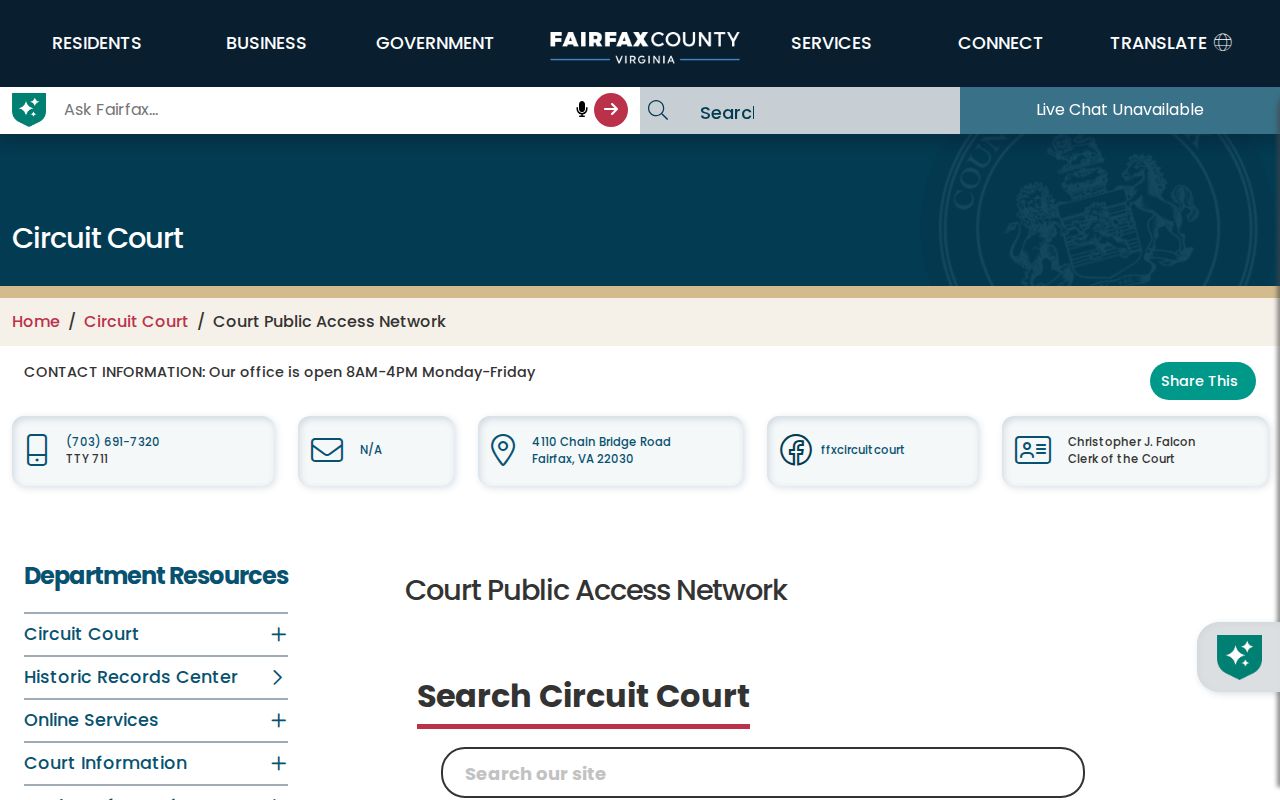
CPAN is one route into the deed trail; public terminals and archival rooms remain necessary for some older or restricted material.
The Fairfax land-record research page describes the courthouse, research-room, and Historic Records Center paths for an address-led deed search.
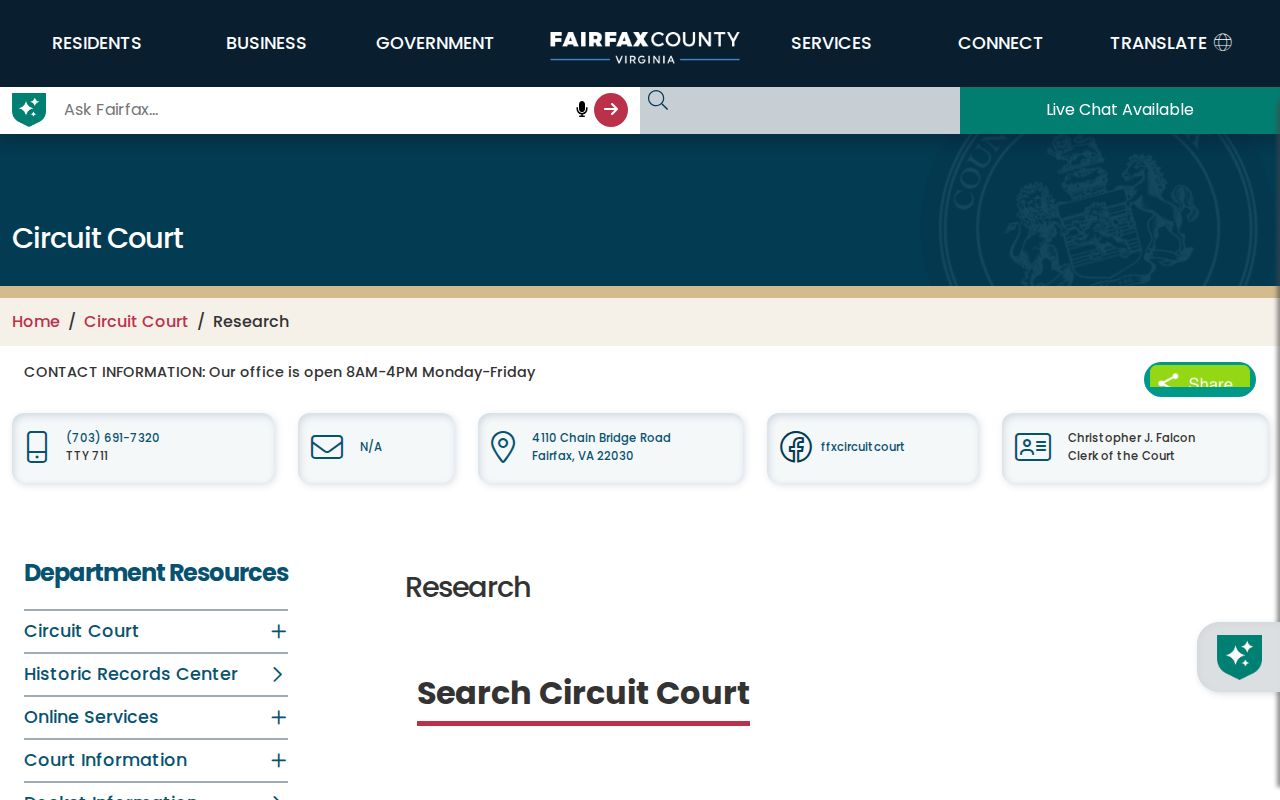
The land-record route is where a parcel-card reference becomes a chain of documents, with the legal description and recording history checked at every step.
Read Springfield Criss-Cross Streets
A criss-cross directory is a reverse address listing: it starts with a street and number, then prints a dated name or subscriber reference. Fairfax's Virginia Room holds the local directory and telephone-book material needed for that historical layer. Hill's regional directories include a 1966, 1968, 1969, and 1971 through 1973 run, while community and telephone publications provide other years. These books are valuable when a deed owner and a printed address differ, but their listings can be selective or voluntary.
Use the exact volume year, normalize the street suffix, and record whether the entry reflects a subscriber, community participant, or another printed category. The Virginia Room has a CPAN station and a microform reader-printer, allowing a reader to compare older printed material with county land indexes. The Springfield directory book identifies the collection runs without turning an old listing into a current claim. Note: A directory entry belongs to the year and publication that printed it, not to a later assessment record.
Match Springfield Street Labels
Older Springfield street research needs more than a modern ZIP and street number. The county did not locate an official, complete Springfield renumbering or renaming chronology. MAR effective, change, and expiration fields are therefore clues, not a ready-made history. Check them against plats, deeds, newspapers, aerial imagery, and the period's directory. A historical street or mailing record may also use Springfield Farm, Corbett, Springfield Station, a subdivision, or a broader Fairfax label.
The post-office history makes that careful comparison worthwhile: county marker research documents a Springfield post office in 1866 through 1868, Corbett in 1907, Springfield again in 1910, and a 1953 move. The suburban record environment changes sharply after the 1950s, when community directories, criss-cross books, and telephone listings join parcel and deed work. For land that predates numbered streets, use tract, parish, road, adjacent-owner, and plat references before forcing a modern address match.
Limit a Springfield Street Directory
A street-by-street search is a record trail, not a universal resident list. iCare can withhold an owner name from its online display, and a missing name should not be treated as a missing owner. MAR is authoritative for site addresses but does not provide an automatic person list. A deed records a legal transaction, while a directory records a date-bound publication entry. Virginia voter files have statutory access conditions and protected fields, and the Citizen Portal is for an individual's own status workflow rather than a street query.
Address Confidentiality Program participants and people protected through court orders may have protected address information. DMV information is not a general address-search route. Use a defined, lawful personal purpose, keep sensitive details out of notes and publications, and confirm a possible match with two independent records. Note: A changed mailing address, withheld owner name, or absent directory entry is a source limit, not proof about a person's location.
Lawful use. Use Springfield street records for legitimate personal, historical, estate, property, or civic research. Do not use an address trail to stalk, harass, intimidate, or harm anyone.
Verify Springfield Addresses Twice
Before relying on a Springfield address-search result, pair the address with a second key. A PIN plus the deed's legal description is stronger than a street name alone. A street number plus a MAR historical status can explain an older directory entry. A party name plus book and page can place a deed in the correct chain. Parcel splits, mergers, trusts, estates, spelling changes, and older road names can all create a false connection if only one field is used.
Keep the source URL, access date, exact spelling, and date carried by the record. That simple record of how a result was reached makes it possible to revisit the county source when an address, assessment display, or directory clue changes.